
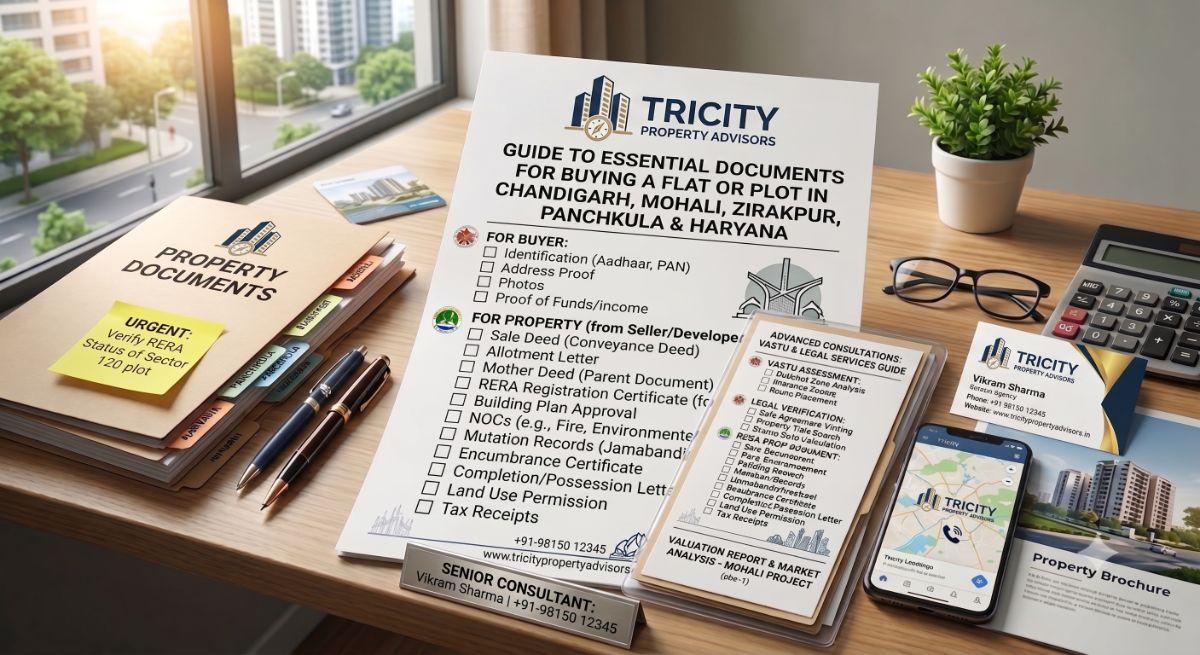
Buying a property—whether a flat or a plot—in the Tricity region (Chandigarh, Mohali, Panchkula) or in fast-growing corridors like Zirakpur and Haryana is one of the biggest financial decisions of your life. Yet, most buyers walk into this process without knowing what information they need to provide, what documents to verify, and what legal checks are non-negotiable. Whether you are a first-time homebuyer or a seasoned investor, this comprehensive guide from Vrock Sovereign Realty will walk you through every single requirement—so you are never caught off guard.
From Aadhaar cards to Encumbrance Certificates, from RERA numbers to Jamabandi records—we cover it all in plain, actionable language.
📋 1. Personal Information & Identity Documents (Buyer Requirements)
Whether you are buying a flat in Mohali Sector 70 or a plot in New Chandigarh's Mullanpur township, you must first establish your legal identity as a buyer. Every bank, developer, and registration authority will ask for these documents without exception.
A. KYC (Know Your Customer) Documents
- Aadhaar Card (Mandatory): Your Aadhaar card is the primary identity and address proof accepted by all banks, developers, and sub-registrar offices across Punjab, Haryana, and Chandigarh UT.
- PAN Card (Non-Negotiable): Under Section 139A of the Income Tax Act, quoting your PAN is mandatory for any property transaction above ₹10 Lakh. Without it, the sub-registrar will not register the property in your name.
- Passport / Voter ID / Driving Licence: Required as secondary identity proof. NRI buyers must submit a valid Passport along with their OCI/PIO card and a Power of Attorney (POA) if they are not physically present during registration.
- Passport-Size Photographs: Typically 4–6 recent passport-size photographs are required for various application forms, loan documents, and registration paperwork.
B. Financial & Income Proof
- Latest 3 Months' Salary Slips: Required by banks for home loan or plot loan eligibility assessment. Salaried individuals must provide payslips from their current employer.
- Income Tax Returns (ITR) – Last 2–3 Years: Mandatory for self-employed individuals, businesspeople, and NRIs. Banks assess your repayment capacity based on declared income.
- Form 16 (For Salaried Buyers): This TDS certificate issued by your employer confirms your annual income and tax deductions, strengthening your home loan application.
- Bank Account Statements – Last 6 Months: All lending institutions require bank statements to verify your cash flow, existing EMIs, and source of down payment funds.
C. CIBIL/Credit Score Report
While lenders pull this automatically, maintaining a score above 750 ensures you get the best home loan interest rates from SBI, HDFC, ICICI, and other banks operating in the Tricity.
🏢 2. Property Documents Required for Buying a FLAT (Apartment)
Buying a flat—whether in a high-rise in Mohali, an affordable project in Zirakpur, or a luxury apartment in Panchkula Sector 20—comes with a specific set of property documents that you must verify before signing any agreement.
A. Builder/Developer Documents to Verify
- RERA Registration Certificate: Under the Real Estate (Regulation and Development) Act, 2016, every under-construction residential project in Punjab and Haryana must be registered with RERA Punjab or HRERA respectively. Always verify the project's RERA number on the official portal before making any payment. This is your single most important protection as a buyer.
- Approved Building Plan: The layout plan of the entire project must be approved by the respective development authority—GMADA (Greater Mohali Area Development Authority) for Mohali and New Chandigarh, PUDA for other Punjab areas, or HSVP/DTCP for Haryana projects in Panchkula and Zirakpur.
- Land Title Deed & Ownership Records: Verify that the developer has clear, unencumbered ownership of the land on which the project is being built. This protects you from future disputes.
- Commencement Certificate: Issued by the local development authority, this certificate confirms the developer is legally authorized to begin construction. Always ask for this before booking.
- Environmental Clearance Certificate: For large residential projects, the Ministry of Environment, Forest and Climate Change requires a clearance certificate. Verify this for larger township projects in New Chandigarh and Mullanpur.
B. Flat-Specific Documents
- Allotment Letter: Once you book a flat, the developer issues an Allotment Letter confirming your unit number, floor, BHK configuration, total cost, and payment schedule. This is your first legal document of ownership.
- Builder-Buyer Agreement (BBA): This is the most critical legally binding contract between you and the developer. It must specify the possession date, penalty clauses for delay, specifications of construction, and all payment terms. Under RERA, this agreement must be registered with the sub-registrar.
- Payment Receipts & Demand Letters: Maintain all payment receipts from the developer throughout the construction phase. These are required at the time of final registration.
- Occupancy Certificate (OC): For a ready-to-move-in flat, always insist on the Occupancy Certificate issued by the competent authority. It certifies that the building has been constructed as per the approved plan and is fit for habitation. Never take possession without this document.
- Completion Certificate: Often issued alongside the OC, this confirms the project is 100% complete as per sanctioned plans.
- No Objection Certificates (NOCs): For high-rise apartments, developers must obtain NOCs from multiple departments—Fire Department, Airport Authority (if near Chandigarh International Airport), Electricity Board, and Water Supply department.
🏞️ 3. Property Documents Required for Buying a PLOT (Land)
Purchasing a plot in areas like New Chandigarh (Mullanpur), Kharar, Dera Bassi, or Haryana's sectors near Panchkula requires an even more rigorous due diligence process since land records in India can sometimes be complex.
A. Title & Ownership Verification
- Original Sale Deed / Title Deed: This is the most fundamental document proving ownership of the plot. Verify the chain of title going back at least 30 years to ensure there are no hidden ownership disputes or liabilities attached to the land.
- Jamabandi (Record of Rights): This is the revenue record maintained by the Patwari and is the most important document for plot purchases in Punjab and Haryana. It records the ownership, possession, cultivation rights, and liabilities on the land. Always get a fresh, certified copy from the official Punjab Land Records portal or the Revenue Department.
- Mutation Certificate (Intkal): Mutation is the process of changing the ownership name in the government revenue records after a property is sold or inherited. Always ensure the mutation is complete and up-to-date in the seller's name before you purchase.
- Fard / Tatima: A Fard is an extract from the Jamabandi confirming ownership. A Tatima is a map of the specific plot extracted from the field map. Both are essential for plot purchases in Punjab and Haryana.
B. Legal Clearance Documents
- Encumbrance Certificate (EC): This is a crucial document that confirms the plot is free from all legal dues, mortgages, or liabilities. Obtain this from the Sub-Registrar's office for the past 15–30 years. A clean EC is a green light for your purchase.
- NOC from Gram Panchayat / Authority: If the plot is in a panchayat area or near a lal dora boundary, an NOC from the Gram Panchayat or the competent urban authority is mandatory to confirm the land use is approved for residential purposes.
- CLU (Change of Land Use) Certificate: If agricultural land has been converted for residential or commercial use, a valid CLU certificate from PUDA or DTCP (Haryana) is mandatory. Purchasing a plot without CLU verification is one of the most common and costly mistakes buyers make.
- Layout Plan Approval: If you are buying in a private colony or plotted development, verify that the master layout plan of the colony has been approved by the respective development authority (GMADA, PUDA, HSVP, or DTCP).
- Licence Number of the Colony: All private residential colonies in Punjab and Haryana must have a valid licence number issued by the government. This confirms the developer is authorized to sell plots in that particular sector or colony.
💰 4. Tax & Financial Information You Must Know
Understanding the taxation framework before buying a flat or a plot in the Tricity is essential to protect your investment and plan your finances correctly.
A. Stamp Duty & Registration Charges
- Punjab (Chandigarh, Mohali, New Chandigarh): Stamp Duty is currently 7% for male buyers and 5% for female buyers on the property value. Registration charges are 1% of the property value. These are paid to the Sub-Registrar at the time of registration and are non-refundable.
- Haryana (Panchkula, Zirakpur areas in Haryana): Stamp Duty ranges from 5% to 7% depending on buyer gender and location within the state.
- Section 80C Tax Benefit: The stamp duty and registration charges paid are eligible for deduction under Section 80C up to ₹1.5 Lakh in the year of purchase—applicable for both flats and plots.
B. TDS on Property Purchase
TDS @ 1% Under Section 194IA: If you are buying a property (flat or plot) worth ₹50 Lakh or more, you are legally required to deduct 1% TDS from the payment to the seller and deposit it with the Income Tax Department using Form 26QB. The seller receives the balance 99%. Failure to deduct TDS makes the buyer liable to a penalty.
C. GST on Flat Purchase
- Under-Construction Flats: GST is applicable at 5% on under-construction residential properties without any Input Tax Credit (ITC). For affordable housing projects, the rate is 1%.
- Ready-to-Move-In Flats: No GST is applicable on the purchase of a completed flat that has received its Occupancy Certificate. This is one of the strongest financial advantages of buying a ready possession flat.
- Plots: No GST is applicable on the purchase of a plot of land.
📑 5. Regional Document Checklist: Tricity & Haryana Quick Reference
| Document / Requirement For Flat Purchase For Plot Purchase | ||
| Government-Issued ID Proof | ✅ Mandatory | ✅ Mandatory |
| Address Proof | ✅ Mandatory | ✅ Mandatory |
| PAN Card | ✅ Mandatory | ✅ Mandatory |
| Income Proof (Salary Slips / ITR) | ✅ For Home Loan | ✅ For Plot Loan |
| Bank Statements (6 Months) | ✅ For Home Loan | ✅ For Plot Loan |
| Sale Agreement / Allotment Letter | ✅ Mandatory | ✅ Mandatory |
| Title Deed / Chain of Title | ✅ Essential | ✅ Most Critical |
| RERA Registration Number | ✅ Mandatory | ❌ Not Applicable |
| Approved Building Plan | ✅ Mandatory | ✅ Before Construction |
| Encumbrance Certificate (EC) | ✅ Essential | ✅ Most Critical |
| Occupancy Certificate (OC) | ✅ For Ready Flats | ❌ Not Applicable |
| NOC from Society/Authority | ✅ Resale Cases | ✅ Required |
| Mutation / Jamabandi Records | ⚠️ Optional | ✅ Mandatory |
Legend: ✅ = Required | ❌ = Not Applicable | ⚠️ = Situational
🚩 6. Red Flags to Watch Out For — Chandigarh, Mohali, Zirakpur & Panchkula
The Tricity real estate market is booming, but with growth comes the risk of fraud. Here are the non-negotiable red flags that Vrock Sovereign Realty always advises buyers to watch out for:
- No RERA Number for Under-Construction Flats: Any developer selling an under-construction flat without a valid RERA registration is operating illegally. Walk away immediately.
- Missing or Unverifiable Jamabandi Records for Plots: If a plot seller cannot produce authentic, recent Jamabandi records or refuses to show the revenue record, treat it as a major warning sign of a disputed or fraudulent property.
- Incomplete Chain of Title: If there are gaps in ownership documents going back 30 years, legal complications may arise after your purchase. Always engage a property lawyer for title verification.
- Colonies Without Licence Numbers: Dozens of unauthorized colonies have come up in the periphery of Chandigarh, Zirakpur, and Panchkula. Buying in an unlicensed colony puts your entire investment at risk of government demolition or non-regularization.
- Pressure to Skip Registration: Some unscrupulous sellers or developers may suggest avoiding registration to save on stamp duty. This is illegal and makes your ownership legally unenforceable. Always register your property at the Sub-Registrar's office.
💡 Final Verdict: Your Smart Buyer's Action Plan
1 Verify Your Budget & Loan Eligibility: Calculate your EMI capacity, check your CIBIL score, and get a pre-approved home or plot loan from your preferred bank before you start your property search.
2 Engage a Qualified Property Lawyer: For any property transaction in Chandigarh, Mohali, Panchkula, Zirakpur, or Haryana—always hire an independent property lawyer to verify all title documents before you sign anything.
3 Verify RERA / Authority Approvals Online: Check the RERA Punjab portal (rera.punjab.gov.in) or HRERA portal for Haryana to verify project registration. Check GMADA/PUDA for plot colony approvals.
4 Inspect Encumbrance & Revenue Records: For plots, personally verify the Jamabandi, EC, and Mutation records from the official Punjab Land Records portal or the Revenue Department office.
5 Register Your Property Without Delay: Complete the registration at the Sub-Registrar's office within the stipulated time to secure your legal ownership. Pay your stamp duty and TDS as required by law.
At Vrock Sovereign Realty, we guide every buyer—whether you are purchasing your first flat in Mohali or investing in a premium plot in New Chandigarh—through every single step of this process with complete transparency and zero hidden surprises. Your dream property deserves a clean, legal, and secure foundation.